
2026-08-24 · 7 min read
HubSpot to Custom CRM: Migration Guide and Costs
Leave HubSpot for a custom CRM: map the data, ship a first version in seven days, spend two weeks on the presented roadmap, and see what the move costs.
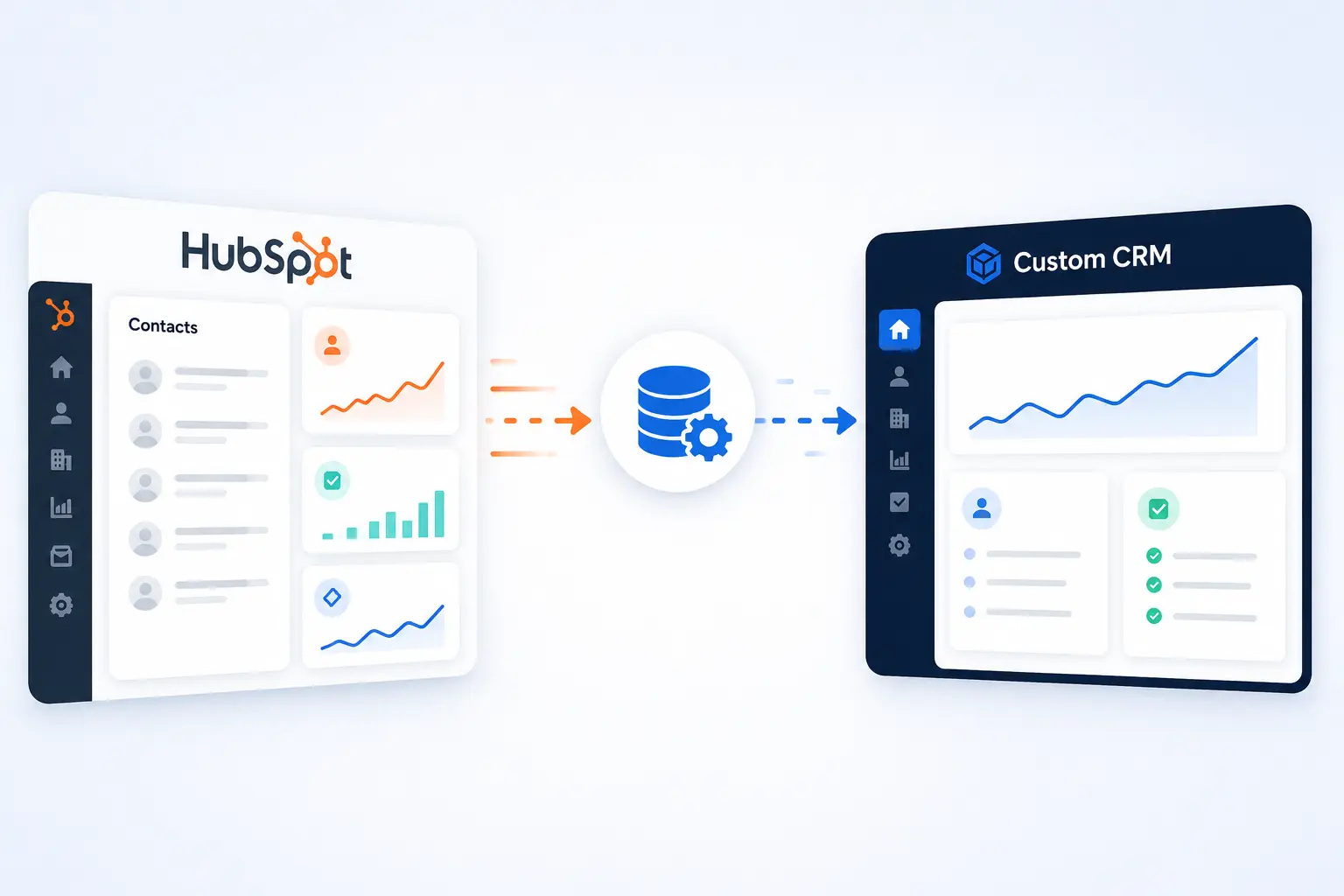
This article is for operators already paying for HubSpot who need a migration plan — not another argument about whether the product is good. You have companies, contacts, deals, and a stack of properties the team half-trusts. The decision here is how to move the system of record to a custom CRM without a silent quarter, and what that move costs.
If a stranger in your industry would recognise your process and HubSpot is mostly helping, stay. Custom development is for the other case: the pipeline is no longer a generic inbound board, seat cost is distorting who sees a deal, and workarounds have become the operating system. Brand-fit questions belong in custom CRM vs HubSpot. This guide is the leave: the data map, the first week, the two weeks that finish a presented roadmap, and the commercial bands.
A custom CRM is a project, not a new HubSpot hub. There is no per-user licensing on the application we build. You pay to lock the objects, move the records that are actually true, ship a first version the team can run, and then finish the plan you already approved. Optional software maintenance is hosting, security, and further development — not a tax on headcount.
What the move costs — and what you are not buying
A HubSpot-to-custom move is not a HubSpot implementation and not a licence negotiation. You are funding a data model, a mapped import, a first release the team can open on Monday, and a short hardening window. On this site that sits on the same bands as any custom CRM: MVP from $2,000, standard from $5,000, enterprise from $15,000. HubSpot does not change the bands. It changes how much of the budget is mapping, cleansing, and deciding what history is allowed to die.
The quiet line item is the export. HubSpot portals accumulate duplicate companies, custom properties nobody trusts, deals stuck in dummy stages, and activities that look complete because a workflow fired. A clean CSV is rare. Budget for mapping, a test import, and a rollback path. That work is why a 'simple' leave often lands in standard, not MVP — even when the new CRM itself is one pipeline.
Run the three-year HubSpot number with actual headcount: seats, hubs you opened to unlock one workflow, unused modules, admin time, and the extra tools bought because the pipeline does not fit. Custom CRM cost is the build, then optional maintenance, with no per-user licensing on the application. If those two totals are comparable and the process is already a competitive advantage, the leave is a commercial decision — not an engineering hobby. Include people who only need a status but still require a paid seat. That line often decides the comparison before the licence does.
Do not budget a clone of every hub you currently pay for. Marketing email can stay in HubSpot if it still earns its keep. The custom CRM should own deals, delivery, and customer status. For the full cost drivers, what belongs in a first release versus later, and the three-year comparison against seats, read Custom CRM development cost. Those ranges are starting points. A project estimate still follows the workflow you send and the HubSpot objects you actually use.
Days 1–2: lock the plan before a single record moves
The first two days are not a workshop pack you file. They are the plan the rest of the week is allowed to follow: objects, stages, owners, which HubSpot properties map, what stays archived, who is system of record for email and invoices, and the roadmap for the two weeks after the first version. If that document is vague, day three becomes folklore and days four to seven become a rebuild of HubSpot with nicer fonts.
We write the jobs the software must do in the first 90 days, then cut them into what ships in week one and what the presented roadmap will finish. Sales should recognise their real stages. Leadership should recognise the report they already argue about. Nobody should be asked to invent a process on a whiteboard while the old portal is still the truth.
The presented roadmap is a dated list, not a mood. It names what week one will not include — the second pipeline, the accounting write-back, the permission that finance asked for on day two — and when in the following two weeks each item lands. If a request cannot be dated, it is not in the plan. That is the document leadership signs before day three. Changing it later is a scoped change, not a hallway conversation.
This is also when coexistence is decided. Many teams keep HubSpot for marketing automation and move operational records out. That is a product decision, not a slogan. If both systems will write the same contact, we name which one wins — on paper — before anyone builds.
Day 3: migrate the CRM you have, not the one you wish you had
Day three is the current CRM. We take the live HubSpot set — companies, contacts, deals, the custom properties that still mean something — and we move what the team uses. History that is noise stays archived. Attachments nobody has opened in two years do not get to delay Monday.
Duplicates get a rule, not a debate in production. Lifecycle stages that were invented to fool a workflow get mapped to the stages you actually run, or they get dropped. Owners who left the company do not remain the owner of half the pipeline. A test import happens before the cutover import. There is a rollback path. This is not a Friday dump.
If the HubSpot portal is archaeology — ten years of unused pipelines, three naming conventions for the same field — day three is still one day because we are not migrating the museum. We are migrating the operating set. The rest can be queried later or left in a HubSpot archive. That constraint is what keeps the first version honest.
Days 4–7: build, test, and leave a first version running
Days four and five are construction. The CRM is built around the objects locked on days one and two, on the data that arrived on day three. Delivery uses current AI-assisted engineering so this is software in a week, not a six-month discovery — the same reason a focused first version can start from $2,000 instead of a catalogue quote. AI is how the week stays a week. It is not a scoring feature the sales team logs into.
Days six and seven are not a demo. They are test and validation: login, the records, the pipeline, permissions that match the roles you named, the report leadership will open. Defects that block Monday get fixed. Nice-to-haves get written onto the roadmap, not hidden as 'we'll squeeze it in.' At the end of day seven the team has a first version they can already use. That is the same promise as custom CRM development: operational in one week, then iterate on software that is already in use.
What that first version includes is deliberately thin: companies, contacts, one primary process, ownership, basic activity, a report that matches the weekly meeting. It does not include every HubSpot workflow, every historical note, or a clone of the report catalogue. Those are how programmes stall.
Two weeks on the roadmap you already approved
The following two weeks are not a surprise backlog. They are the remainder of the plan presented on days one and two: the extra validations, the permissions that were too sharp to rush, the integration that kills the weekly CSV, the automations that only make sense once people are clicking, the fields that day-seven use proved were missing.
This is how you avoid the classic failure of custom software — a silent month after a pretty demo. The first version is already the system of record for the painful weekly job. The two weeks harden it. If something was not on the presented roadmap, it does not sneak in as 'while you're in there.' It goes to optional software maintenance or a later slice.
Cutover is a date, not a feeling. From that morning the custom CRM is the system of record for deals and customer status. HubSpot may still send the newsletter. It does not still own the pipeline. Staff stop dual-keying. If someone cannot work without HubSpot on Wednesday, the first version was not ready — that is a days-six-and-seven failure, not a reason to keep two truths alive for a quarter.
At the end of those three weeks you should have a CRM the team runs, HubSpot reduced to whatever it still does well, and a written next phase. That is a migration. Recreating every hub so nobody feels they lost a checkbox is a different project, and the wrong one. Scope and process for the product itself are on the custom CRM development page. Cost bands and what to leave out of v1 are in Custom CRM development cost.